I know it has been a SUPER long time since the last time I have posted on this blog, but times are a changing...and with the changing times comes a new announcement:
As of September 1, 2016, I am now an editor with Polished Paragraphs, a newly formed boutique editing company.
Check us out at www.PolishedParagraphs.com!
Blessings,
T Denise Clary
Showing posts with label Editor. Show all posts
Wednesday, September 7, 2016
Times are a Changing...New Announcement for 2016!
Wednesday, April 16, 2014
Great News....It's Official!!
Great News!
It is official (actually, as of April 11, 2014), I am an Associate Editor with The Zharmae Publishing Press and I couldn't be more thrilled!
I had been offered a contract for employment as my internship neared an end on April 10th. My internship was very rewarding as well as equally stressful, busy, and challenging; which is why I had very little time to post on my blog. It was all worth it in the end!
I am very excited and look forward to this new employment chapter in my life, and thank God every step of the way! I ask for your continued prayers and support as I embark on this new adventure.
Blessings,
T Denise Clary
Wednesday, September 12, 2012
Guest Blogger: Editor Jennifer Moody "Be an Inspiration to a Young Writer"
Be an Inspiration to a Young Writer
A
few months ago my daughter’s 2nd grade Teacher asked me if I would
be a guest speaker for her class to discuss writing and editing with her
students. I showed up with the book “Eats, Shoots, and Leaves” and we all sat
in a circle on the floor and read through some of it. After discussing the
importance of editing (in between giggling over the book’s examples), we moved
on to the topic of being/becoming a Writer. I showed them a few magazine
articles I’ve written and they thought it was cool that I had a by-line. I told
them that unlike other career choices, you don’t have to be a grown-up before
you can start. Anyone, any age, can be a Writer. Of all the things I talked to
them about that morning, THIS one was the topic that would not be dropped. They
were fascinated … they could be a Writer right now? Even though they’re only 8
years old? …Yep.
“The expert at anything was once a beginner.”
~Hayes
The
kids were more into it than I thought they’d be. Several of them shared with me
that they write, or like to read, etc., but there was one particular little boy
who asked me a dozen questions. The Teacher said, “That’s my little Harry
Potter reader right there.” He was a sponge, asking questions, sharing his love
for reading and writing. I left there hoping, praying, that I made some kind of
impact on the kids, this boy especially, because he so clearly has a love of
the art. (Maybe he’ll be famous one day and dedicate a book to “Mrs. Moody who
came to my 2nd grade class and told me I could be a Writer.”)
The
Principal (who stopped in to hang out for some of my visit) asked me if I’d
come back to guest speak to other classes. She said higher grade levels do
creative writing and she thought having me visit with them might boost
confidence and get the creative juices flowing. I happily agreed, not only
because I want to help, but because of a past experience…
When
I was in the 9th grade, my English Teacher told us we were going to
do a three week long poetry project. I was beyond thrilled. I had been writing
poetry, secretly, for a few years. After class I shared my secret with her, and
she asked if she could read my work. I had never shared my poems with anyone,
so this was a big deal for me that someone actually wanted to read my work. The
next day I brought my folder of poems to school and gave them to her. I had
zero confidence in myself back then, and I think I said something like,
“They’re not very good, but here they are.” I walked into class every day and waited
expectantly for her to give me some feedback. After two weeks I asked her about
them and she said she hadn’t had a chance to read them yet. The next day I
walked into class and saw my folder on her desk. I was excited and nervous to
hear what she thought of my poems. She called my name and when I got to her
desk she handed me my folder without saying anything. Working up all my
courage, I asked her if she liked them. She dismissively said, “Yeah, they’re
good.” I knew, without a doubt, that she was lying – she hadn’t read them, or
hadn’t read much. I was crushed.
Looking
back, I can see that she was probably just busy or distracted. I’m sure she has
no idea the impact she had on me. But it would be ten years before I shared a
poem with anyone again, when I wrote my Mom a poem for Mother’s Day. Even
though it was my mother, I was terrified to give it to her. She read it, hugged
me, and through tears said, “This is the best Mother’s Day gift I’ve ever
gotten.” That was a turning point in my writing confidence. (Thanks Mom.)
As
an Editor I am sometimes asked by Writer friends to read their work and give my
opinion. Some Writers are trying to break into the Editing field and ask for my
advice. I help everyone as much as I can—whether they’re asking for suggestions
on building up an editing business, or requesting pro-bono editing for their
seedling novel—if I can do it, I do it.
If
you’re a more seasoned Writer or Editor … contribute, inspire, encourage. Look
at a beginner as a potential comrade, not competition. The world of greatness
has plenty of room for all.
"Keep away from people who try to belittle your dreams.
Small people always do that, but the really great ones
make you feel that you too, can become great."
Small people always do that, but the really great ones
make you feel that you too, can become great."
~Mark Twain
Be
a “great one” to a young writer. I promise you that one day that beautiful karma
will come floating right back to you.
Be
blessed, y’all.
Jen
Jen
Thursday, July 26, 2012
Guest Blogger: Editor Jennifer Moody "The English Language"
The English Language
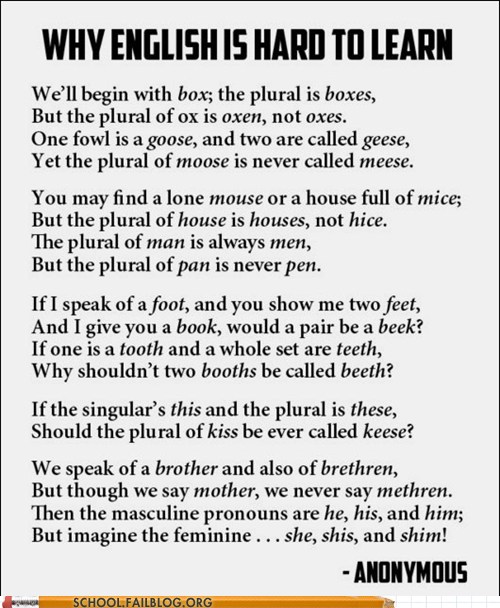
A friend sent the above image to me today and I laughed myself to
tears. If English is your first language, as it is mine, you probably don’t
think too much of it. But you have to admit, especially after reading this …
our language IS pretty crazy. Kudos to anyone who learns it as a second
language. I know I wouldn’t want that challenge.
So on this note, my guest blog for today is more of a
suggestion…
Be patient with anyone whose first language is not English.
Whether it’s a verbal interaction or a written one – if they’re struggling with
it – think of this blog and be considerate. God created so many languages for
His people, and for the most part we’ve learned to communicate with each other
pretty well. Sometimes I think He did this to challenge us, and maybe to test
us a little … our compassion, our kindness, our tolerance.
"Kindness is a language which the deaf can hear and the
blind can read." ~ Mark Twain
Be blessed, y’all.
Jen
Thursday, June 21, 2012
Guest Blogger: Editor Jennifer Moody "Choose Your Words Carefully"
Choose Your Words Carefully
“The
difference between the almost right word and the right word
is the difference between the lightning bug and the lightning.”
~Mark Twain
is the difference between the lightning bug and the lightning.”
~Mark Twain
I read a lot of books (it goes with the territory). I’m open to pretty much any genre (except the really scary horror stuff … I’m a big chicken). Authors who have a true, molded gift for writing can blow me away with their work. Sadly, that doesn’t happen as often as I’d like. But oh when it does … I question whether I’m talented enough to read my Kindle while driving down the interstate. (I don’t, of course. Kids – don’t try this at home, er, on the road…)
My
daughter makes fun of me because I often refuse to read books that everyone is
raving about. Oh, I’ll read them … later. I don’t know why, but I don’t want to
read them when everyone else is reading them. So I wait … and read them six
months later when all the hootin’ and hollerin’ has subsided. (Twilight and The
Hunger Games are two that come to mind.)
Then
there are books that I know I will never
read, no matter how much people rave
about them. For example, I had NO plans of reading 50 shades of anything
whatsoever. Everyone I knew was reading it and asking me if I had (um, no), but
when will I (um, never). I didn’t care how well it was selling; I know darn
well that sales don’t always have anything to do with the quality of work. It
wasn’t until an Editor/Author friend asked me if I’d read it to give her my
opinion (she wanted to know “what’s the big whoopin’ deal with this book?”)
that I relented. By chapter five I could no longer take the horrible word
repetition. I could not sit back and just read because every time she described
something and followed it with “…oh my,” I thought … Ugh, she said it again! Why didn’t her Editor tell her she’s saying “oh
my” too many times?!
It
happens 72 times in the book, y’all. SEVENTY-TWO TIMES.
...Enough
about that. The point here is, when you’re writing, choose your words
carefully. Read, reread, write, rewrite. I know, I know, I’m always saying
that, but seriously, think about the picture you’re painting. See if you can
re-word it in a way that makes the reader form his own image, rather than
always doing it for him.
“Don't
tell me the moon is shining;
show me the glint of light on broken glass.”
~Anton Chekhov
show me the glint of light on broken glass.”
~Anton Chekhov
The
world needs more Anton Chekhovs. You’re out there. I’ve read your work (even if
they weren’t talking about it on the morning show; in fact, especially if they weren’t talking about
it).
Thank
you, to all the wonderful writers out there, for sharing your gift with the
world.
Jen

Monday, April 30, 2012
Guest Blogger: Editor Jennifer Moody "Grammar Geek Gripe - The Apostrophe"
Grammar Geek Gripe – The Apostrophe
I was trying to come up with a GREAT
topic for this month’s Guest Blog, but after seeing THREE “let’s add
apostrophe-s to make our noun a plural” signs in the past couple of weeks…
…I’m feeling a very strong need to talk
about apostrophes today.
Nothing gets under my grammar geek skin
more than an apostrophe incorrectly placed, or the wrong apostrophe-type word
used. We’ve all had conversations about there/their/they’re. In fact, a Facebook
friend tagged MoodyEdits recently in this funny:
(While it did crack me up, I couldn’t
stop myself from pointing out that the period after “Nazi” should be a comma,
and there should be a period at the end. Ha! The point, however, was nicely
made. Moving right along…)
Let’s / Lets
Last August, Old Navy reprinted thousands
of college team shirts because of an apostrophe catastrophe…
They had to, really. How would it look if
thousands of COLLEGE kids were walking around sporting grammatical errors?
(I wonder if Old Navy added an Editor to their staff after this
mishap.)
It’s / Its
Ugh… it pains me, PAINS me, to read this
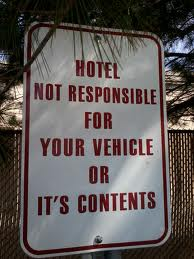
sign:
I think this has to be my biggest
apostrophe-whine… using it’s for the
possessive. It’s is a contraction for
it is—nothing else—ever—under any
circumstance. If it is to be possessive, there is NO apostrophe. End of story.
Unbendable rule. Please help me spread the word.
“It’s important to put
an apostrophe in its proper place.”
(I wish the world would learn this simple sentence.)
Okay, I could go on for days …
you’re/your, who’s/whose … but you get the point. (And I know T Denise Clary’s readers
feel my pain.) So I’m going to step down off my soapbox. It’s (notice the
correct usage) a beautiful day. Let’s (there it is again) go out and enjoy it!
Be blessed!
Jen

Tuesday, October 11, 2011
GUEST BLOGGER ~ Editor Jennifer Moody
The Importance of Editing – From an Editor’s Viewpoint
**For a limited time, Jennifer with MoodyEdits is offering a special discount on editing services. Scroll down to the bottom of the post for additional information**
![]() |
| Editor and Writer Jennifer Moody |
I have been proofing other people’s work since 1999. When you edit for a living, you don’t get to turn it off at 5pm and go on with everyday life. The editor-eye is always searching. I have seen more errors on things that I don’t give a darn about… billboards on highways, banners on buildings, signs on doors… mistakes are everywhere. When I see one of these, I think, “Good LORD, didn’t you have somebody READ that before you made it 50 feet tall???” …Guess not.
When I’m editing to-be-published material (that would be the stuff I DO care about), it’s a whole different story. As a writer myself, I can relate to the writer’s position. I know from experience that no matter how many times you read through your own work, you’re going to miss something. (Right now I’m re-reading all this, thinking… if I have a mistake in this blog about editing that will look pretty sad! I probably will though, since it won’t be professionally edited. Whatchagonnado.)
While I offer a variety of editorial services, my bread-n-butter work is monthly national magazines. My normal editing process for a magazine feature goes something like this:
· Read-1: I read through it first, just getting a feel for its flow. (I make corrections as I see them, but it’s not the point of the first-read.)
· Read-2: Second read is done as a word-for-word, not really taking in the story on this round. (I catch a few more this way.)
· Read-3: Then I officially turn on the eagle-eye and read again – fixing any errors I catch along the way. (This is also the round where sentence restructuring is done, should the client want heavy copy-editing, which my magazine clients do.)
· Read-4: This round is done as a safety-net, because even editors miss things once in a while. (Hard to believe, I know; but alas, it is true.)
· Read-5: Final round – I sit back and read it as a READER. (Usually there is some sentence restructuring here too.)
Five rounds of proofing for each feature—with perfection as the ultimate goal—is how you get a beautiful “book” (as they call it in the magazine world) in the end.
When editing a book to be submitted for publisher consideration, the process is a bit different, but the goal is the same… perfection. Because the last thing a publisher wants to see when considering a book, is a book filled with errors. If you didn’t care, why should they? There are too many people out there begging for their book to be considered, for the publisher to invest their time reading a book that the author didn’t invest in. You have to do your job first, or they’re going to put it down and pick up the next one. And what you end up with is a rejection letter…and a reputation.
Professional book editing runs about 1.5-2 cents per word (more if rewriting or ghost writing is involved). If you’re serious about getting your book published, it is the best investment you’ll ever make. When the publisher reads through your work, they won’t be putting it down and grabbing the next one. They’ll keep reading. That’s the goal—to keep ‘em reading—all the way to the end!
If you are self-publishing an e-book, the importance of proper editing is not lessened. Sure, it will be published either way; but now, instead of a publisher stumbling over errors, it’s the reader. And if your first readers are tripping and falling, they won’t finish it, they won’t recommend it to their friends, and they won’t write a good review (or even worse, they’ll write a bad one). If that happens, ALL your blood, sweat, and tears you put into your work was for nothing. Because it will sit on Amazon or Smashwords for months, with a handful of sales (at a few bucks each) and a couple of bad reviews. At that point it’s dead in the water. And not just that book… any book that e-publishes after that with the same author’s name, already has a strike against it. Readers won’t hit that “buy” button if they’ve already been bitten.
When you have invested so much into your work, do not skip the last step. Have an editor go through it with a fine-tooth comb, giving it that final polish so it shines. THEN publish it. If money is an issue, shop around. There are good editors out there offering slightly lower than average rates to build up their business. And know your options… such as paying for a chapter at a time rather than the entire book at once. When you get to pay for it in pieces it becomes way more affordable. You won’t get the editor’s input on the entire book’s flow, but you’ll get each chapter edited, which is a big step in itself.
Another option, if money is really tight, is joining a book writing group. I belong to one that meets twice a month. Writers bring single chapters of books they’re working on, and read them out loud (while the rest of the group follows along with their own printout). After the reading, we go around the table giving our input… page 3’s second paragraph is confusing, consider changing such-and-such so it flows better, etc. As an editor in a writers group, I sit there marking up my copy as I listen to the author read… editorial freebies.
Whichever editing route you take, it’s better than not taking it at all. The important thing is to make the investment in your work so it pays off. With any kind of product, if the quality isn’t high it won’t sell, or at least, not for long. A book is no different.
Jennifer Moody
![]() |
God Bless!
T Denise Clary
Subscribe to:
Posts (Atom)